Tuesday, 4 June 2019

For pride, amidst all chaos

Sri Lanka v Afghanistan, ICC Cricket World Cup 2019, Cardiff

The last time I took a shot at penning my thoughts in to a blogpost, Sri Lanka Cricket were at the crossroads. The giants of their game had bid adieu to the national team, taking with them a brand of cricket the cricketing world had come to acquaint and love with the little island. The shadows of their illustrious careers loomed over a young, untested yet talented crop of cricketers, who had shown glimpses of what they could become. No one expected the young group to emulate their predecessors, certainly not immediately, but there was no suspicion of a downfall. There was no question that this team couldn't compete at the world stage, consistently and proudly. That was soon to be wiped away from the avid Sri Lankan fan. Pride was not something they had ever found scarce. But series loss after series loss, captain after captain, coach after coach, Sri Lankan fans were drained of every ounce of pride they had in their team, only to be left with memories of an era gone-by to soon. As such, the ability for me to gather my thoughts to write anything that was even slightly far from bitter, faded away; along with the blog.

Three years later, on a relatively cold summer day in Waterloo, I sit at my couch, having witnessed one of the most tenacious performances of this Sri Lankan team. They had shown they had the mettle. In the UAE, they had toppled a strong Pakistani side in their adopted backyard. At home, they had swatted away touring Australian and South African sides, with turning pitches and Rangana Herath's darts. And against all odds in South Africa, they had slayed Goliath; a feat that has drawn praise and envy from their northern neighbors. But all these performances had come in the Test format. The One Day side, in the same time period, had failed to win a single significant series. No other full member side had a worse win percentage than the men in blue and gold, since the last world cup. Fifty seven different players used under six different captains, Sri Lanka's ODI side was in complete chaos going in to the world cup. So much so that, they appointed a captain who had not featured in the One Day side since the last world cup.

Under such circumstances, even a win against the lowest ranked team in the tournament; Afghanistan, seemed like an uncertainty. At 100/1 it seemed surprisingly probably. Kusal Perera had raced to a half century, belting boundary after boundary. He had made history, earlier in the year, being at the forefront of the series win in South Africa. If Sri Lanka were to make any substantial performance at the world cup, he was the man to lead them with the bat. Newly appointed captain Dimuth had held fort, and helped lay a foundation. He too, a hero of the series win in South Africa having united the team to play for a common cause, which probably was what warranted his appointment as captain for the world cup. It was a refreshing start, to a team that had been bundled out for 130ish at the hands of New Zealand. 

But not long after being 100/1, Sri Lanka were 180/8. The win seemed impossible, and the performance; more like the Sri Lanka of new. The fans had been given a glimmer of hope, and then had it all taken away in the blink of an eye. A feeling they had become accustomed to of late. Then the city of Cardiff decided to unleash the heavens. The game was halted until the skies cleared. Sri Lanka got a break. The fast bowlers turned up. And the rest, as they say, is history.

Eight years ago, Nuwan Pradeep was gearing up to bowl his first ball in test cricket against Pakistan. He is fondly called Sirasa by his teammates; the name of the television channel that had conducted the soft-ball fast bowling talent contest which he had won. That is how he had started his hard ball career. Within a few years he had climbed the domestic ranks, and earned himself the right to play for the National Test team. If Pradeep winning that contest was the equivalent of Charlie Bucket winning the golden ticket to Willy Wonka's chocolate factory, then today was the ride on the Great Glass Elevator. Afghanistan are not the greatest batting prowess of the tournament, but with 180 to win in 41 overs, they definitely were the favorites to win this game. That was until Pradeep decided to show how much he deserved to be there, and how much hard work had gone in to his game since his soft-ball days.

Lasith Malinga had gone through a roller coaster ride in his cricketing career in the years after the 2015 world cup. He was made captain, then not. Then blamed for his lack of fitness, and ultimately dropped. There was controversial comments made between him and the sports minister. He went unpicked for the first time at the IPL in 2018, and was kept in the dressing room as a fast bowling consultant. Then last summer, Malinga turned up to the most obscure location for a T20 league; Toronto. I watched him bowl; with far less strides to his run up, and far more deep breaths. But he got wickets. And with the wickets, he got his mojo back. He got the fact that he has still got it. I got a selfie, but that's less important. A little under an year later, with a last over for the ages, he nicked the IPL title from CSK's backpocket in the final. And today, he roared. He roared like the Malinga of 2007. He roared like he belonged, and he wanted to be belonged. He delivered.

To think Sri Lanka are out of the woods with this win is nothing short of foolish. This team is still well beneath the water, and in the middle of chaos. The win does not give hope. It shouldn't. The middle order is still frail. Spinners; non-existent. Fielding; barely adequate. But a loss here, to Afghanistan, would have been the white flag. That would have been the final nail in the coffin, for the Sri Lankan Cricket fan to lose the slightest shimmer of pride they had for their team. But they won. Absolutely out of nowhere. Cardiff was stunned; Colombo even more so. The team had not given us something to be proud about, per say. But they had ensured we would not lose what little we had. And that much, for now, is more than enough. 

Enough, even for me to be inspired to write again.

Cheers.


Thursday, 11 February 2016

Sri Lanka's Love affair with school cricket

Royal College 1st XI vs Wesley College 1st XI at Campbell Park

Wesleyite pacer Helitha Bambaranda floats one on a full length to the left handed Geeshanth Panditharatne, teasing him in to a drive, dangling a carrot outside off, looking for the edge. The red ball is only 9 overs old, and the Royalists are already two down for not much, yet the Royal skipper does not hesitate in leaning in to a cover drive and dispatching the ball to the grass banks of Campbell Park. There is a touch of poetry and majestic elegance to the whole ordeal. It's 10.30am in Colombo and midnight in Waterloo, Ontario. After a combined total of about 15 hours through the whole week, I find my self staying awake, staring in to my laptop screen. Because March Madness is here, and the games are on!  

Sri Lanka's love for the timeless game, through the ages, has been one of fantasy and fairy tale in nature. From the streets and ally ways to the open paddy fields, there is no lack of abundance in the number of games of cricket being played in the island. May it be hardball, or softball or even at times with a piece of paper rolled in to a rather odd spheroid, cricket is played and loved with a passion that even the inventors of the game can often be jealous of. But Sri Lanka's love for school cricket specifically, is a whole other romance novel altogether. 

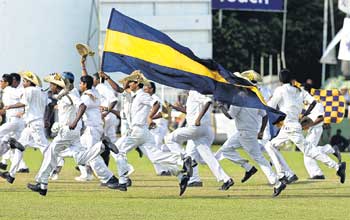
Let alone the one bump games in the class rooms and interval cricket carnivals, age group level cricket in Sri Lankan schools play a major role in building School spirit and enhancing comradery, not only with those within, but with also with those in other schools. The papare bands, the flag flutterers and the flag flickers, the cycle parades, and the crowd packed big matches, all have added unique essence to this story of utmost passion and love for both cricket and for Alma Mater. From age group level ranging from under 11s to the under 19s, cricket is by far the most competitive sport at school levels as well, and easily the most watched and followed. School boy cricketer of the year awards, college colours awards, and big matches highlight a school boy cricketer's career, while drawing awe from his school mates, creating heroes and legacies that even outlive the cricketers themselves. Therefore there is no question as to how much enthusiasm and hype there is created towards the month of March and the "Big match season". To an avid cricket fan, and to the school boy and old boy alike, there is much to look forward to.

A school cricket match in Sri Lanka could not be anymore different than just a regular school cricket match.
It is so much more than just a school event.
And it is even more so much than just a cricket match.
Young Pasindu Sooriyabandara is only 16 years old, and already he's laid a premise as to what sort of prodigious talent he holds, notching up two centuries in his debut 1st XI season. He gets one rising right around his nose which he rocks back and hooks towards the boundary. The fielder at fine leg runs across, puts in a full length dive and gets his hands to it, but cannot hold on. The ball rolls in to the ropes. Cricket is a game of such fine margins. A couple of years ago young Pasindu would not have dreamed of playing in front of camera's and his name being mentioned in live commentary. Certainly, not before the big match, at least. But Sri Lanka's love for school cricket has grown so much that the desire to see more school games has been timely fed with live streams and ball-by-ball commentary, not just in the big-matches but also in a selected few regular season matches. Pasindu gets out in the next over. His story has only just begun, and he has a long way to go. But one thing is for certain, he has made massive strides in his path. And with the introduction of the live streams, so has schools cricket in Sri Lanka.

How lovely it would have been, a couple of years ago, to see some of these regular season games at the touch of your fingertips. Big matches feature the biggest schools and the biggest rivalries, but sometimes, the best in game rivalries between players, are not necessarily in the big matches them selves. A 2009 Ananda College vs Trinity College would have featured two of the best schools batsmen at the time in Dinesh Chandimal and Udara Jayasundera up against arguably the best spin bowling duo at a school level since Piyal Wijetunga and Muththia Muralidaran, in Rushan Jaleel and Akila Jayasundera. Or a 2010 game between Royal College vs St. Sebestians' College, which would have featured the Sri Lanka u19 top order of Bhanuka Rajapakse, Kithuruwan Vithanage and Ramith Rambukwella, tussling it out against the Sri Lanka U19 pacemen Sanitha De Mel and Vishwa Fernando. The legend of the superstar all rounder that never made it in the national circuit, in Wesley's own Ryan Kern. The 1000 runs and 100 wickets double of Shameera Weerasinghe of St Josephs. Don't even get me started on the St. Peter's lot. Angelo Perera, Shevanga Ranasooriya, Chathura Pieris, Akshu Fernando, Andri Berenger and all the rest of them. 

A Sri Lankan's love and loyalty towards their school, and the passion and adoration for the game of cricket, entwines and combines to morph in to these majestic fairy tale events called big matches. The class of the Trinity-Anthony's, the flair of the DS-Mahanama, the camaradarie of the Richmond-Mahinda, the pure quality of the Joe-Pete, the unparalleled brotherhood of the Ananda-Nalanda and the unmatched traditions of the mother of them all; the Royal-Thomian, have all added their own distinct chapters and story-lines in to this massive romance novel of Sri Lankan schools cricket. At times, it is far greater than that of the international level game, and definitely more endearing and closer to the heart of the Sri Lankan cricket fan.

Royal move on to a commanding score, beyond 150 for the loss of 3, with the aid of Geeshanth and his deputy Thiran Dhanapala. But these games are valued far beyond just scores and results. This is the first real taste for these cricketers of competitive cricket at a level when there are more than just your coaches and parents watching. When the expectations are not just in the dressing room and and at the dining table. When the pundits and experts aren't just old coaches, and past cricketers, but also 12 year olds with flags taller than their own height, and old boys with attitude and "glorious pasts". This is their first taste of the passion of spectators for the game they play. 

And now with their names, and their performances, their repertoire of shots while batting and artillery of variations while bowling, all available to anyone who wishes to tune in via a live stream, the love story of schools cricket in Sri Lanka has begun a new chapter. And it is one that promises a whole lot to look forward to.

Specially to those who's hearts are so near, yet the eyes so far. 

Cheers.
Kumma

Wednesday, 21 October 2015

A New Crop with a New Attitude

Sri Lanka v West Indies, 1st Test. Galle

A bright ray of sunlight glistens upon the ramparts of the Galle fort. Lengthy shadows loom over the players, a cool evening breeze relaxes them while also giving a slight chill. It sets the tone for Sri Lanka cricket's current state of affairs. The sun has set. Shadows of retired legends loom over the younger generation. A calming, yet fear inducing breeze of responsibility blows over them. But as often as the sun sets, it also inevitably rises the next morning.

A charismatic left hander crunches artistic cover drives to the boundary. An equally flamboyant right hander aesthetically guides the ball down to third man. The West Indian fast bowlers run in to bowl, and walk back towards their marks in almost a cyclic procession, most of the time with hands on their hips. The lone spinner is being carted to every corner of the ground. They have put on over 200 runs together. Both go on to make 150+ scores. Only a few months ago, only one such pair existed in the Sri Lankan batting line up. Sangakkara-Jayawardane would have been the only name that would be able to follow up to that description. But on this day in Galle, it was Dimuth Karunaratne and Dinesh Chandimal who had lit up the city by the sea.

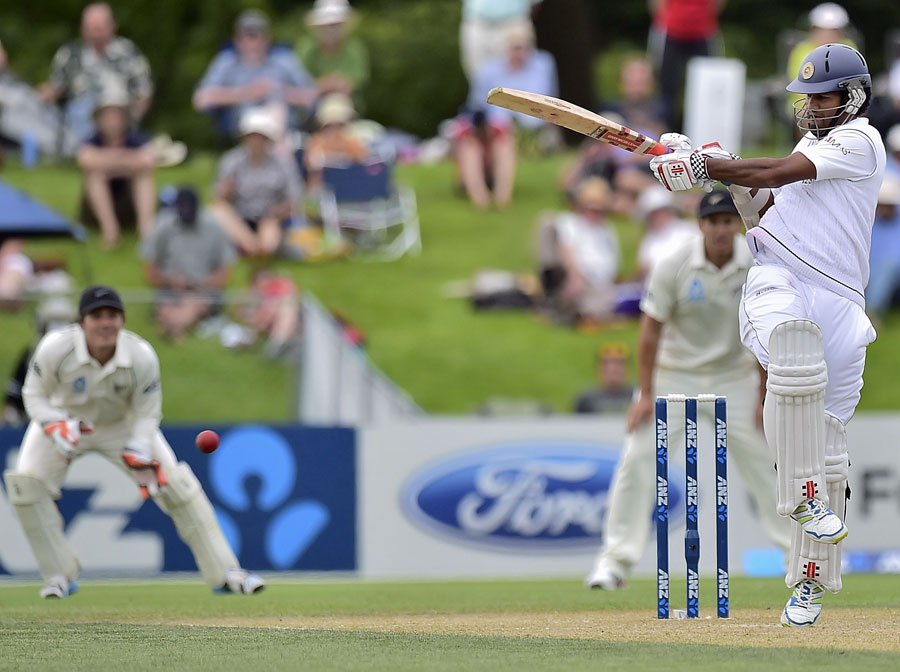
Dimuth is an artist with the bat. A kind of artist who you know can paint as well as Picasso, but never seems to finish his work. But on the off day that he does, it is a sight to savor. To watch such an innings is a pleasure that needs to be cherished and relished. He has made his highest test score, and perhaps the most enjoyable knock so far in his relatively short career. It could be argued that his century in New Zealand, on a 4th innings pitch, against what probably is the best new ball pairing in the world was a much more tougher, grittier and a more crucial innings, but simply on pure aesthetic brilliance, this innings trumps all that has preceded it. 

Chandimal is a contrast. His approach batting is one of authority. Of dominance and aggression. Take nothing away from his stroke-play, but his sheer ability to take the attack to the bowler overwhelms any technical skill he can ever showcase. Russel Arnold mentions in the commentary box that Chandimal has evolved in to an attacking player. From having changed in to a technical, and a steady batsman, he has found his comfort zone as an aggressor and has returned to it. Although this maybe news to Russel, if he asked any Anandian who watched their 1st XI cricket team between the years of 2007 and 2009, they will tell you that this is the Chandi that they know, and the only Chandi that they have ever known. Chandimal is a top 4 batsman. He is also an attacking top 4 batsman, who has strokes to reach any corner of the ground, to any bowler. Chandimal knows it. So does anyone who has followed his career closely. It is the selectors who needed to realize it. 

Most of all, the pair look relaxed at the crease. The whole team looks relaxed. In the dressing room, and out on the field.

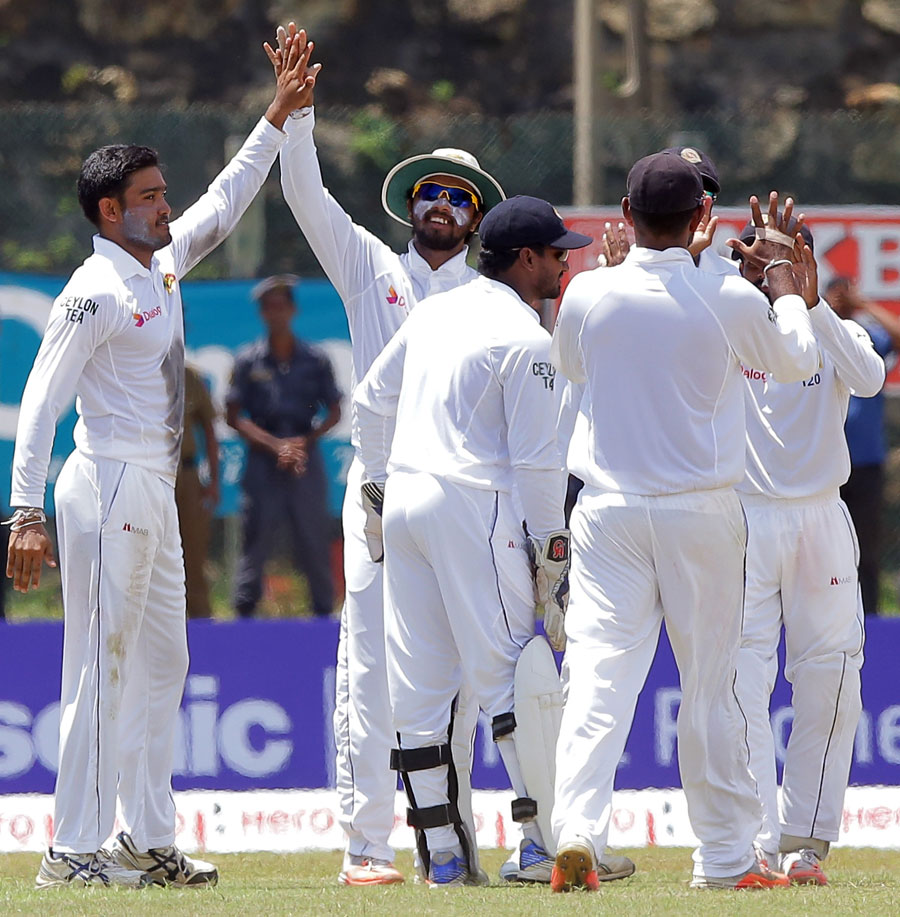
Nuwan Pradeep has bowled a long, tiring spell from the fort end. He takes a rest at fine-leg, but is called back to his mark to bowl one more over. He wipes the sweat from his brow, huffs and puffs towards the crease, and delivers a peach from round the wicket to the left handed Darren Bravo, just outside off, on a length. Bravo has to play at it, and the ball just about leaves him, but kisses the edge. It is a picturesque dismissal for a fast bowler. "SIRAAAAAAA", screams Mathews at first slip as he runs in to hug Pradeep. Sira is short for Sirasa, Pradeep's nickname he earned by being picked in the national side via a soft ball competition organized by Sirasa TV. At the other end, Milinda Siriwardane is pushing darts through to the batsman's pads. Kusal encourages him on. "Come on bambara!". It is a reference to a music video Milinda was a part of. Everyone is on a nickname basis. It is not a privilege being used by just the seniors. From captain Mathews, to Kusal who is only playing is 2nd test, refers to his team mates in their nick names. They are a bunch of friends playing together. Relaxed. And enjoying the game.

After a long standing era of ayyas and mallis,
Sri Lanka cricket has evolved in to a team of equals.
A bunch of friends, enjoying the game.
Sri Lanka's cricket culture has always been built on a bilateral relationship between the "Ayyas" and the "Mallis". From junior levels, through club and provincial, right up to the national team, the ayya-malli relationship is what defines the outline of the team's culture. The Ayyas have all the authority, and demand respect. In turn, they take care of the mallis, groom them, and help them in difficult situations. It is a rather symbiotic relationship, but a very daunting one for a youngster. Something that expects more from him than just cricket. With the ayyas now having retired, the ones that are left are all only separated by a couple of years. They have almost all played in the schools circuits during the same 3-4 year period between 2006 to 2009. They represent a more easygoing, impulsive and brash generation. And it shows in their cricket. Above all, it shows in their team spirit.

But not all the team members are as young and brash. Rangana Herath is only a few games away from retirement. He is the last remaining "ayya" of the team. He warms up to bowl the next over. "Range ayye, welawa aran adaganna. Hadissiyak na", says Mathews. He tells Herath to take his time and stretch, and that there's no rush. There is respect in those words. Also concern, towards a champion bowler, and a senior citizen in the team who needs to be looked after. Herath prods to the crease, swivels his body weight as slowly as a Leyland lorry taking a bend, and bowls a rubbish half-tracker. Marlon Samuels tries to hoick it in to the Indian ocean, but he misses the ball altogether, and it strikes his thigh pad and rolls on to the stumps. Kaushal Silva at short leg jumps on to him in delight. Herath winks. He knows it's a rubbish ball. But is reaction is what brings a smile to the team's face. In a team full of energetic, fun loving, youngsters, this old soul is no misfit. 

Sri Lanka's win against West Indies was rather an easy one, and also an emphatic one. It will only make their team spirit stronger. But tough times are ahead, and defeats will be inevitable, with tours to England and South Africa in the vicinity. Yet the thing to most look forward to, about this new crop of players and their new approach towards the game, is that when you are playing with your friends, at the end of any series or tournament, regardless of whether you win or lose, your friendship will still remain, and you will continue to be the same bunch of friends. These friendships will spark enough enjoyment for them to be inspired to be better, not just as a team, but also as individuals.

Tough tides, yet bright skies ahead.
Cheers,
Kumma

Thursday, 20 August 2015

The Break Up of a Love-Hate Relationship

Sri Lanka v India, 2nd Test, P. Sara Oval

----------------------------------------------------------------------------------------------------------------------
Cognitive Dissonance; 
the state of having inconsistent thoughts, beliefs, or attitudes, especially as relating to behavioral decisions and attitude change. Simply, it is how you could absolutely love a person to bits, and yet have qualities that you despise to the core. Benito Mussolini banned Jazz music in Italy during its Axis years. Jazz music was said to be vile due to it's African origin, Jewish popularity and liberative and radical themes. Yet, Mussolini was a massive Jazz fan. His fourth son Romano, went on to become one of the most famous Jazz pianists in the world. Jazz caused Mussolini to be inconsistent, and hypocritical. It is said that only Humans are capable of such complex contemplation.
---------------------------------------------------------------------------------------------------------------------- 

It is the morning of a week day in 2003. The Sri Lankan cricket team has returned from South Africa after a rather disappointing World Cup performance, losing to Kenya, and being pummeled by both India and Australia in the Super Six stages, and losing the semi final against Australia after being in an extremely commanding position. Australia made 212 in their 50 overs in that game. 91 of them coming off Andrew Symonds' bat, who was given a life when he hadn't even crossed double figures by Kumar Sangakkara, who missed the easiest stumping chance in the world. To make it worse up on him self, he then ran out Aravinda De Silva in what was the Sri Lankan World Cup hero from 1996's last ODI game ever. The memory still lingers in the mind of the avid cricket fan, but on that morning in 2003, it was as fresh as the dew on Torrington Square, which we drive past on my way to school. The Sri Lankan cricket team is having a jog. A van carrying school boys go past them. "GANDASTHAAARAAAAAAA", a boy shouts. It roughly translates to Stinker, and it echoes through the team, and all those around. It is aimed at Kumar Sangakkara. Kumar Sangakkara is a villain.

Four years later, I wake up at 6am to watch the Sri Lanka vs Australia 2nd Test at Hobart. Overnight, Sri Lanka had ended at 247/3, Sangakkara 103* and Jayasuriya 33*. They needed 260 runs to win their first test in Australian soil, and with 7 wickets in hand, Sri Lankan fans had grown hopeful. I switch on the TV. I check the wickets column before I check the score. 8 down. Game over. I check the score. 302/8. Sangakkara on 148 not out. He dances down the track to Stuart Clark, and whacks him over cover. He does it again. And again. At least once every over. He makes 192, the highest score by a Sri Lankan batsman in Australia. Rudi Koertzen gives him out caught behind, off his helmet. Sangakkara is livid as he knows he had a chance to win the game for Sri Lanka. But it is not to be. Sri Lanka lose by 96 runs. Kumar Sangakkara has perhaps played the most memorable innings by a Sri Lankan, even more so than Sanath's 340 or Mahela's 374. Kumar Sangakkara is a great batsman. He may not be a villain now, but he is not yet a hero.

In December 2009, my best friend and my self are studying for Advanced Level exams. We have 8 months to go, and we don't know jacksh*t. Yet, with a pocket radio, we are listening to a Sri Lanka vs India game at Rajkot. India have scored 414, the highest total against Sri Lanka in an ODI. Upul Tharanga and TM Dilshan make 180 in 22 overs. Tharanga gets out. Sangakkara strides in. No one expects him to score quicker than Tharanga, let alone Dilshan. No one expects him to smother the bowlers over the ropes as he wishes. But he does. He plays a blitzkrieg innings of 91 off 43 balls. He gets out, and a procession follows and Sri Lanka end up losing by just 3 runs. But Kumar Sangakkara has played the most defining innings of his career. He has evolved in to the complete modern day batsman. Yet, he is still not a hero.

In 2014 April, at a friend's house, me and my friends gather around his television to watch the final of the T20 World Cup against India. Sri Lanka are chasing 131 to win their first global silverware since 1996. Dilshan gets out; 41/2. But Sri Lanka have Mahela Jayawardane, their man for a crisis, the big game player, the only man who has centuries in a world cup final and a semi final. Sangakkara is also at the crease, but he is only there to play a supporting role to Mahela's world cup winning innings. 65/3. Mahela throws is away against part-time spinner Suresh Raina. And now, Sri Lanka are only left with Angelo Mathews, Sangakkara and the all rounders and bowlers. But Sangakkara bats like the man he always promised he would be. He bats till he gets a 50. And he bats till Sri Lanka win the world cup. He bats until he turns him self, and Mahela in to world champions. He bats until he has turned him self in to a hero.

Kumar Sangakkara is a hero. 

He was not born one. He was not earmarked as one as a school boy. He was not made in to one as he arrived or as he blossomed. But he batted and batted until he turned him self in to one; until everyone on the field, and everyone on the ground, and everyone watching at home knew for certain that he was one. 
Kumar Sangakkara; the consistent, the masterful, the eloquent. The Hero. 
Within this period, he had scored test hundreds in every country barring the West Indies, where he has only toured twice. He had captained Sri Lanka in two world cup finals. He had given the Collin Cowdrey Lecture, a speech in cricketing lore had been equalized to that of Martin Luther King or Nelson Mandela. He had won the hearts of many. But not mine. Not for certain. There were times I loved him and times I hated him. There were times I loved that I hated him, and times that I hated that I loved him. Basically, Kumar Sangakkara and I have been having a Love-Hate relationship for 15 years, that he has no idea about. An unhealthy, cringe-worthy, teeth-grinding yet awe inspiring affair. Kumar Sangakkara is my proof for cognitive dissonance. I think I hate him, yet there are things about him that I absolutely love. And he will always remain to be a hero.

But such an unhealthy relationship must end. And on the last day of the this test, it will. Whether I like it or not, Kumar Sangakkara will walk out of the P.Sara Oval, and will never be seen again in a Sri Lankan jersey. And quite possibly, in a few years time, I will look back and say, he really was the best we ever had. And on that day, my relationship with him, and my cognitive dissonance, would have come one full circle.

Cheers Kumar,
Thank you for everything.

Thursday, 12 February 2015

Why Do We Fall?

ICC Cricket World Cup, Australia & New Zealand, 2015

"Batman" is perhaps the most successful superhero movie franchise. Although Superman is probably the ultimate superhero, who as explained in Kill Bill; doesn't need an alter-ego to turn in to a superhero, and although X-Men may have the longest list of movies made about them, Christopher Nolan's Batman is miles and miles ahead of any other superhero movie franchise in the sense that it incorporates all the great aspects of a good movie; a great script, brilliant acting and most of all astounding cinematography. And "Why do we fall, Bruce?" is perhaps the most significant line in what is perhaps the best superhero trilogy movie series that will ever transpire upon us. 

In more than one way, Sri Lanka cricket has taken a fall in the months past. Apart from a two scrappy ODI wins against New Zealand, two very gritty test innings from Dimuth Karunaratne and Kumar Sangakkara, and a home drubbing of a depleted England side carrying Alistaire Cook's dead weight, Sri Lanka cricket hasn't had much to cheer about in the bygone months since November. Malinga's injury, Sachithra's action scandal and the lack of experience in the rest of the bowling attack bar Herath, is perhaps Sri Lanka's biggest concern. Chandimal's lack of form, Dimuth's questionable inclusion, Jeewan and Thisara's confused roles as all rounders have also added to Sri Lanka's misery, and if not for Thirimanne clicking as an opener, Sri Lanka's batting would also have been in disarray not just at the bottom of the order, but also at the top. Sri Lanka are still on paper one of the top four contenders for this world cup, but on recent performances, they might not even be rated in the top 8. 

But it is a fall that should not surprise us. Sri Lanka's three biggest match winners are at the twilight of their careers, and as every great era ends, it is bound stir up chaos. Between Sanga and Mahela, they have captained 4 world cup finals. Exclude Sanath Jayasuriya from the list, and Sanga, Mahela and Dilshan would top every One Day batting record in Sri Lanka from most runs to most hundreds. They are as of 2014, World Champions. The three of them have featured in 5 world cup finals for Sri Lanka. As far as franchises go, they are the Batman Trilogy of Sri Lanka Cricket. And when you are so successful as a franchise, as you come to your end, people tend to expect so much more. For me, Batman The Dark Knight Rises, was the poorest of the three batman movies. Yet, it was one of the best superhero movies I've ever watched. But for the Batmas series, since it is preceded by two legendary movies; "Batman Begins" and "The Dark Knight", "The Dark Knight Rises" was simply just not good enough. Specially, because it was the final installment of the series. Specially because, after that, it would be no more. Mahela, Sanga and Dilshan and Sri Lanka cricket face the same conundrum. Just like Christopher Nolan, they have simply out done themselves, and there is no ultimate finale they could ever come up with, that could completely satisfy the masses. 

In their 8th and last cricket world cup together,
Sanga, Mahela and Dilshan find themselves in need of a farewell script
that outdoes their illustrious careers.

Sri Lanka find them selves facing the two best sides of the world cup in their group stages, Australia and New Zealand. In England, they face the next best suited attack for the conditions. Bangladesh have caused an upset in every other world cup; 1999 not 2003. 2007 not 2011. The pattern suggests 2015 is their year to pull a rabbit out of the hat. Afghanistan are perhaps the most dangerous associate side in terms of attitude, and Scotland as West Indies found out the hard way, are not push overs either. Given the form of the players, given the group, and given the conditions, Sri Lanka's group stage fixture card is a formula for disaster. Therefore, like the fate of a franchise depends on a spin-off that saves a dying series, Sri Lanka's fate largely depends on not how Dilshan, Mahela and Sanga will perform, but on how much Angelo Mathews can squeeze out of the likes of Thirimanne, Jeewan, Thisara, Kulasekara and Herath. The fact of the matter is, if the big three fail, 9 out of 10 times Sri Lanka will lose. But even if the big three perform, without significant support from the rest, Sri Lanka will not go too far. Players will win you matches, but it is teams that win tournaments.

Therefore after a rather inauspicious start to what seems to be an extremely tough tournament, Sri Lanka will need to put the losses to South Africa and Zimbabwe behind them and learn what they can learn. If Chandimal is under-performing, Dimuth has proved he's a capable number 4, with Mahela and Angelo shifting down one spot each. Death bowling is the biggest concern, and if Malinga is injured, Sri Lanka need to figure out which one of Angelo, Thisara or Lakmal should partner Kulasekara at the end. Or maybe roll the dice with Chameera. And Jeewan needs to bat like the 30 year old, mature, talented batsman that he is. His bowling is a bonus. Jeewan Mendis is a batsman. He should remind himself to bat like one. 

"Why do we fall?"
"So that we can learn to pick ourselves up".

May it be in this tournament it self, or in the times that follow after the retirement of three of Sri Lanka's greatest cricketers of all time, it is high time that Sri Lanka learn to pick them selves up before it is too late.

Cheers,
Kumma


Friday, 30 January 2015

Mahela's Unlikely Partner

ICC Cricket World Cup, Australia & New Zealand, 2015

The 2015 ICC Cricket World Cup will be the last world cup for many of Sri Lanka's recent legends. With the obvious ones of Mahela Jayawardane, Kumar Sangakkara and TM Dilshan, once you start noticing the ages of the rest of the team, it is a quick realization that this would also be the last world cup for Rangana Herath, Lasith Malinga and Nuwan Kulasekara. But world cup or no world cup, we would still probably be fortunate to see all these players in the national jersey for a few more games after the conclusion of the world cup, Dilshan having already stated that he hopes to continue playing ODIs and T20s, and Sanga being pushed by Angelo Mathews to continue in Tests for another year, at least. Everyone, but Mahela Jayawardane. The last match Sri Lanka play at this world cup will be the last international game Sri Lankan fans will see their uni-browed, baby-faced, down to earth yet sometimes grumpy, immensely talented hero in National colours. When the last ball of the last game Sri Lanka play is bowled, the Mahela Jayawardane epic will most certainly end.

Mahela's career has been highlighted by many wonderful records. Highest individual test score for a Sri Lankan, partnering with his mate Sanga to bring up the world's highest partnership for any wicket in the same game, scoring more hundreds at a single venue than any other batsman, and even becoming the first Sri Lankan to score international centuries across all formats, his records are merely a highlight as to what this man has truly achieved as a Sri Lankan on the world stage. But his most interesting record, one he has lost in recent years, is something for statisticians to die for. From 1998 to 2011, Mahela scored 13 ODI hundreds, all of which resulted in victories for Sri Lanka. In the 90s when Sri Lanka's wins were determined by how many runs Sanath Jayasuriya scored, to the 2010s when the probability of a Sri Lankan win were dependent on how long Sangakkara would stay at the crease, Mahela's contribution to Sri Lankan wins during that middle period usually goes unnoticed. Specially, the ones in chases. In big chases. Chases that require more than a run a ball, with less than 5 wickets in hand. Mahela's been part of many such chases. But if I were to pick my top 3 of such chases, all three would have one common factor other than Mahela; His partner. 

Until the century he made at the 2011 World Cup Final,
Mahela had scored 13 ODI hundreds and all of them had resulted in wins for Sri Lanka.

In the late 90s and the early 2000s, when Sri Lanka were 5 down, and needed 6 an over to win the match, Mahela being there till the end was simply just not enough. Sri Lanka had a long tail. They didn't have the likes of an Angelo Mathews to come in and finish the innings with a sensible innings. Nor did they have the luxury of a big hitting Thisara Perera who could bring the required run rate down to 3.5 in a matter of 12 balls. But they did have one man. A slender, enthusiastic bloke from Galle, who took more pride in his fielding than his bowling or batting, who boasted of a record of being the only sub-continental spinner to take a 10 wicket haul in Australia, who hit bowlers out of the ground with sheer timing, and a variety of innovative stroke-play. bowled leg breaks that made Shane Warne proud, and took catches that defied gravity; Mahela's perennial partner in chases; Upul Chandana.

Maiyya and Upula's partnership goes back way before Sanga even made his debut as a Sri Lankan cricketer. It goes right back to Mahela's first ODI century, in a game made famous by Ross Emerson calling Murali for chucking, and Arjuna Ranatunga leading the team off the field in protest. Sri Lanka vs England at the Carlton United Series in 1999 at Adelaide was a game marred by controversy. On top of the no-balling and boycotting, Alec Stewart, Darren Gough and Roshan Mahanama got them selves in a verbal pickle during the chase as well, and it was only fitting that Murali had the last laugh by scoring the winning runs. But much before Murali took his revenge, the chase of 303 for Lanka's win was shaped through two magnificent one-day innings. At the time, just 21 years of age, young Mahela Jayawardane strolled out to the wicket at 8 for 2, in the 4th over. He watched Jayasuriya race to 50 in 30 balls before he too gave it away. Hashan and Arjuna provided him experienced company and playing an innings of class, with masterful stroke play and more importantly one of great character and the ability to absorb pressure, he brought up his first one day century before the two of them departed. They were followed by Chaminda Vaas to leave Sri Lanka at 235/6 in 42 overs. Mahela was in, but with 68 needed in 8 overs with only 4 wickets left, he simply had too much to do on his own. That was when Upul Chandana joined Mahela. With Mahela timing the ball crisply, Chandana taking charge to the English bowlers, they put on 34 in 22. Chandana gave the impetus the Sri Lankan inning had lacked since the departure of Jayasuriya.  Mahela was dismissed for 120, a first of many match winning hundreds, but Chandana continued to marmalize the English, taking Darren Gough to the stands with a massive six over midwicket. By the time Maiyya and Upula were done, Sri Lanka needed only 15 runs in 15 balls, having reduced the gap between run and balls left by about 20. At a time when 300 was deemed unchasable, Maiyya and Upula had helped Sri Lanka accomplish the impossible. Together they had committed day light robbery, and it was a first of many to come.

Upul Chandana is an unlikely big hitter. He is an unlikely match winner.
Most of all, he's the most unlikely player to have partnered up with Mahela,
in so many successful run chases.

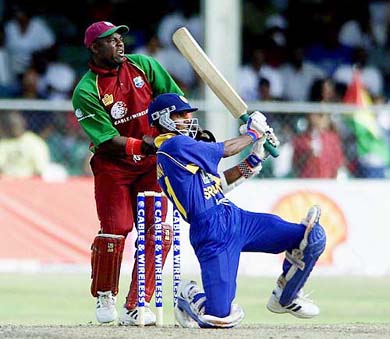
5 years later, in Bridgetown, Barbados, Sri Lanka were chasing another 300+ target against the West Indies. Earlier Brian Lara had ripped the Sri Lankan bowling line up shreds by making a faster than run-a-ball hundred helping the West Indies to a total of 312, and at 192/4 in 35 overs, the Sri Lankan chase was all but over. Chandana having been sent in at number 5 as a pinch hitter, was joined by Mahela who came in at 6, needing 130 runs in 90 balls to win. Together they put on 101 in 13 overs, Chandana scoring a whirlwind 89 with 6 fours and 4 sixes. Mahela didn't score a single boundary, but made a vital 32, knocking the ball around, and giving Chandana the strike to carry out his onslaught, a knock that probably still is one of the best One Day innings by a pinch hitter, promoted up the order to run havoc, during a chase. Once again they had come together to pull off heist, and again they had done it away from home, taking it to those who had called Sri Lanka "home tigers" at the time. 5 years ago, Mahela had won the man of the match award for his 120 in the chase, this time, the award was Chandana's. But the two of them, and everyone else in the ground, and everyone who watched both games, knew that it was their coming together in both games, that turned the game in Sri Lanka's favor.

But their best partnership together didn't come in a massive chase. It came on a slow pitch in Dambulla, during the Indian Oil Cup triangular series in 2005 against India, chasing only 220. Sri Lanka were 95/6 when Chandana joined Mahela. This time, they didn't need to chase at over a run-a-ball. They didn't need to attack  They needed 125 runs in 25 overs with only 4 wickets in hand, and Maharoof and the two fast bowlers to follow. They needed to bat sensibly. On a windy night in Dambulla, under lights, lots of dew from the lake, in swinging conditions, and a wearing pitch, Mahela and Chandana, slowly pulled off a win right from the jaws of defeat. And what's more, this time they finished the game together. Mahela made a memorable 94* and Chandana; a mature 44*. They had come full circle. From Adelaide, to Bridgetown to Dambulla, together they had conquered and mastered all types of chases, In a time when Sri Lanka were done when Jayasuriya got out, Maiyya and Upula had taught the Sri Lankan public that it's not over till they had their say, and they had done it multiple times, to prove that it was no fluke. In the hearts of the passionate Sri Lankan cricket followers. they had become the ultimate partners in chases. While there is not argument that Sanga is the tonic to Maiyya's Gin, it needs to be remembered that Upula was the "chase" to Maiyya's Scotch. 

Sanga-Maiyya would be the partnership the whole world would remember.
But the Maiyya-Upula adventures hold some of the best ODI memories
for the Sri Lankan cricket fan.

16 years have gone by since the day they pulled off their first heist together, and it has been quite a while since the unlikely chronicles of Maiyya and Upula have joined Sri Lanka's cricketing folklore. 4 illustrious world cups later, Mahela has decided this would be his last. Chandana has called it a day for quite a while now, and he will join the likes of me and us fans in tuning in to watch Mahela make at least one more match winning hundred. To Chandana, his unlikely partner in chases, and to me, as Chandana and Mahela are my two favorite Sri Lankan cricketers of all time, it would be a gift from the gods above if Mahela could chase down a big score in Australia for one last time, 16 years later, in the very land he announced him self to the world.

Fingers crossed,
Kumma


Wednesday, 28 January 2015

The Obligatory World Cup Rant

ICC Cricket World Cup, Australia & New Zealand, 2015

After a disappointing ODI series against New Zealand, Sri Lankan cricket fans have flocked in numbers to throw their opinions around social media as to why Sri Lanka are having such a bad run in New Zealand, when they were expected to be one of the top contenders for this world cup. Blaming selection mishaps, pointing fingers at under performing players and by glorifying those who were not selected, they have already come to a consensus that Sri Lanka are already out of the tournament, before it has even begun. 

One of the main talking points about the whole selection fiasco, is the leaving out of Upul Tharanga and Kusal Perera, and naming Dimuth Karunaratne, to which Sanath Jayasuriya has come out and admitted that he did actually make a blunder. Well of course, every time you drop and select players to the ODI team based on Test performances, it really needs to be considered a blunder. When Lahiru Thirimanne was Sri Lanka's man of the series at the Asia cup as an opener, he was dropped from the ODI side later on his Test form. Selecting Dimuth after his 150 at Christchurch was merely the opposite end of the stick of that same blunder. But, to be fair to Thirimanne, he has got his place back thanks to the continuous failure of both Kusal and Dimuth. And to be honest, Sri Lanka's opening problems end there, because Thirimanne is a much better batsman than Kusal, Tharanga and Dimuth, having the technique to survive the new ball, and also to accelerate when needed with the big shots. He's sort of a hybrid between all three prior names. The blunder was not to name him the opener in the first place. Dimuth's selection and Tharanga's omitting were just sub-blunders that followed.

Realistically speaking, Upul Tharanga being left out is not a blunder at all. If Sri Lanka dropped TM Dilshan, or Angelo Mathews, that would be a blunder, because these are players without who Sri Lanka would not win the world cup. Upul Tharanga maybe a vital cog in the machine, but he's not what Dwayne Bravo is to the West Indies. The opening slot has been filled perfectly by Thirimanne, and Upul Tharanga's argument ends there. He has no place in this team. With Dimuth as the reserve opener, as of now, he won't even make it as a reserve. 

With Thirimanne slotting in as the opener, all this rubbish about
Tharanga not being selected needs to end.

But Dimuth as a reserve doesn't make sense either, because Sri Lanka do not have a reserve middle order batsman for this world cup. With Jeewan Mendis's failures, this weakness has been thoroughly exposed. Sri Lanka should ideally have taken an extra middle order batsman, who bowls a bit, pretty much a like-for-like replacement for Mendis to the world cup. Some one in the mold of Ashan Priyanjan, or Kithruwan Vithanage. Even a Chamara Kapugedara would have sufficed. But the real option would have been to take the big hitting, dart throwing Angelo Perera, a Sri Lankan version of JP Duminy/Suresh Raina almost. Since he wasn't given enough opportunities before the world cup as Sri Lanka persisted with the can't bat-can't bowl-can't field-Seekkuge Prassanna, Angelo Perera's name would not even have appeared on the probable list. But from the recent try outs, at least Priyanjan should have made the cut.

It is what it is for now. The squad actually isn't half as bad. It's a lot stronger and more balanced than the one we had in 2011, where Thilan Samaraweera, Chamara Silva and Chamara Kapugedara were our middle order accumulators, and Dilshan and Mathews was the only batsman who could bowl, and Kula was the only bowler who could bat. This time, in Dilshan, Mahela and Sanga, Sri Lanka have a wealth of experience. In Mathews they have form and confidence. In Herath and Kulasekara, they have dependability. And in Chandimal, Thirimanne, Thisara, Jeewan, Prasad, Sachithra and Suranga, they have immense raw talent. And if they are lucky, they will also have Malinga, who is an army on his own. 13 out of the 15, have ODI high scores which are 40+. 10 out of the 15 have ODI best figures of more than 3 wickets. On paper, this is team can beat anyone.

Sri Lanka's most important matches of the group stage, contrary to popular belief, are not the ones against Australia, New Zealand and England. It is the three games they play against Bangladesh, Afghanistan and Scotland. Because those are the three games they need to win, to make it to the quarter finals. Any win against the top three teams, would only be a bonus, not to face South Africa at the quarter finals. The other 3 teams from group A may take any order, including even the West Indies, if they manage to bat 50 overs. And unlike any other world cup since 1999, this one doesn't have ONE clear front runner, and is an open tournament. Three teams; South Africa, Australia and New Zealand look to have greater odds, but the other teams are not far behind.

In truth, Sri Lanka, for the first time since 2003 are not one of the top 3 favorites. On recent form, their chances of making past the quarter finals are dim. But once Sri Lanka get the wins against the bottom 3 teams in their group, they are only 3 knock out games away from winning the trophy. They play their quarter final at the SCG due to higher ICC ranking than England, as the hosts play in MCG and at Eden Park. The wicket at the SCG turned heaps during the recent New Year's test. Who knows what might happen once we are in the knockout stages.

As a team, if they are to impress more than they did against New Zealand, Sri Lanka need to up their fielding. Chandimal needs to get his act together at number 5 or 6. Thisara and Jeewan need to contribute more consistently with the bat and ball, or one of them will have to make way for a specialist bowler, in which case Chandimal will have to be extra responsible as Sri Lanka will only be fielding 6 batsmen. The bowlers will need to find ways to curb the runs at the death, specially the likes of Kulasekara and Herath will have to step up to the plate, this probably being their last ODI world cup as well. And the big three along with Mathews will have to deliver big. 

In the 2011 Final, Thisara Perera's cameo announced him to the world.
This time around, more consistence will be expected from him

As Sri Lankan cricket fans, we tend to place our hopes in one of two extremes. Either we will beat everyone to the ground and win the cup, or we will lose to even Afghanistan and get knocked out. We are so passionate that we either need to be all hopeful and positive, or completely disappointed and hopeless. The middle ground is to be realistic of what this squad can achieve, and try not to be too hopeful neither too pessimistic.

Reality is that odds do not favor Sri Lanka to win the world cup this time around, but what Sri Lankans need to realize is that you don't need to be favorites to win a World Cup. The world cup has been won by underdogs too. That is the only way we've won this cup previously anyway. Because odds don't determine wins. Players do.

Adios,
Kumma

Sunday, 28 December 2014

Cometh the hour; Cometh the man

Sri Lanka vs New Zealand, 1st Test, Day 3, Christchurch

Dimuth Karunaratne averages 30 in Test cricket. It is not an average between a bunch of centuries and half centuries and a series of single digit scores. It is an average of a numerous 30s, a seldom half century and a few low scores. An average doesn't necessarily give an idea how many runs a batsman will score in a particular innings, but for Dimuth it does. He almost always get a start, gets to 30. He bats like he's in the form of his life, middling it off the pads and off the hips, cutting and square driving like a hundred is only a few deliveries away. And just when you feel like no one's going to stop him, he gets out. But when ever he does, he gives you the feeling that one of these days, he's going to dig in, hold his composure and go on to make a big hundred. Today was that day.

At the start of the 3rd day in Christchurch, Sri Lanka were 84 for no loss, following on, and still trailing New Zealand's first innings score by 219 runs. The ball was 35 overs old, the atmosphere was cloudy and overcast, and Trent Boult and Tim Southee were running in from either end fully charged. Kaushal Silva got a brute that nipped away from him at chest height, to which he got a feather of an edge. The world's #1 Test batsman at the moment could only manage one run, before he too nicked one behind to the keeper. In a matter of minutes after the start, Sri Lanka were 2 down for 94. An innings defeat loomed in the distance, with 3 days of cricket still left to play. That's when Dimuth Karunaratne decided to play the innings of his life, yet.

He left the ball on line. Anything along the fourth stump line was left for the keeper to collect. Anything on the pads, were whipped through midwicket for runs. When teased with width outside off, on a length and on the full, he calmly refused. Anything short and wide, he latched on for boundaries. The balls that attacked the stumps, he defended back to the bowler. He played as good as any Lara or Tendulkar could have played on a seaming pitch. He stonewalled like any Dravid or Du Plessis ever did. In a time when Sri Lanka have struggled to find openers who could play long innings, when they have run out of options for batsmen who have the temperament to bat for long periods under pressure, when batsman who can dig deep and bat out draws are only seen on television, when the Marvan Atapattus, the Asanka Gurusinghes and the Thilan Samaraweeras seemed to have been a thing of the past, Dimuth Karunaratne stepped up to the plate and delivered a knock that resurrected the old gritty Sri Lankan Test batsman. A knock that the team was crying out for, given the situation. By the time he was cleaned up by a peach of a delivery by Boult, he had spent over 8 hours at the crease, faced 363 balls, batted across four sessions and amassed 152 runs that ensured Sri Lanka wouldn't lose by an innings in the space of 3 days. Dimuth Karunaratne had arrived.

Dimuth Karunaratne's maiden Test hundred could not have come at a better time,
in terms of the context of the game, and the need of another solid opening batsman for Sri Lanka.

He was aptly supported first by Thirimanne, who batted with the sort of calmness and serenity associated with Sangakkara. Although he seems to have a problem getting past the 20s, his knock today was far more important than the runs. He too blocked away over a 100 deliveries, before he again fished at one he should have left alone, for the second time in the game. Angelo Mathews came in and batted like he can only be dismissed by suicide, like in the first innings. Mathews isn't the most skillful batsman in the Sri Lankan team. He's not even in the top 3 in that list. But he compensates for his limited skill with an extremely good temperament, the sort of mental toughness that made players like Steve Waugh and Graeme Smith in to world class cricketers even with limited technical ability. He continues to bat on, as Sri Lanka sit unstably on 295/5, still trailing by 10 runs, with only PJ to come in next from the batsmen.

Sri Lanka should have gone to stumps only 4 down though, all four of which were earned by the New Zealand bowlers. Kaushal and Sanga got two gems early on in the day, and Dimuth probably got the ball of the match. Thirimanne did get out chasing a wild one, but it was a crafty bowling change by McCullum to bring on Neesham at that stage that brought the wicket. The only wicket that was gifted was the one of Dickwella. Dickwella undoubtedly is one of the most talented and flamboyant young batsmen in the Sri Lankan circuit at the moment, but the reasons to play him as a specialist Test batsmen is a baffling one, specially when Dinesh Chandimal is warming the bench. A Test number 6 needs to be a batsman prepared to bat for long durations, in energy sapping conditions, partly supporting a senior top order batsman, or farming the strike with the tail. Dickwella is neither. If Sri Lanka are to seriously challenge foreign bowling line ups, they should be looking for a batsman in the mold of Mike Hussey, Paul Collingwood or  Faf Du Plessis, who have both the skill and the mental capacity to bat under pressure. For such a criteria, picking between Dickwella and Chandimal should be a no-brainer.

Although most would have expected Sri Lanka to fold and lose by an innings, and although one good spell from either end is all it takes for this game to be wrapped up during the first hour tomorrow, Sri Lanka have already done them selves proud by taking the game in to the 4th day. If Mathews can replicate what he did in Headingley earlier this year, and the likes of Kaushal, PJ, Dhammika and Eranga can bat around him, by taking session by session, Sri Lanka can still set up a significant 4th innings chase. If the three overs he faced were any indication of his technique, Tharindu Kaushal should be an able partner to Mathews for a few useful runs tomorrow. PJ is experienced and tough, and he will put up a fight before he goes down. Dhammika Prasad used to be his school's opening batsman and Shaminda Eranga has a first class hundred to his name. Sri Lanka have fought well for 4 sessions so far, and a couple more from here and they will feel they can take enough momentum from this game in to Wellington to force a win there. Sri Lanka do not have to win this game to come out of it proud, they do not even have to draw. They have already shown their fighting spirit that they continued to show through out the year, and what ever they do from here will only enhance it. But either of the former results, would be far more pleasing. 

Regardless of that result, the confidence gained by a hundred that might spark a long illustrious career for one Dimuth Karunaratne is priceless for the future of Sri Lanka cricket. In their hour of need, he was hero that Sri Lanka deserved.

Another long, hard grind awaits,
Until then,
Adios,
Kumma

Saturday, 27 December 2014

Moving on the Fast Lane

Sri Lanka vs New Zealand, 1st Test, Day 2, Christchurch

Sri Lankan private buses are known for causing road rage in the busy streets of Colombo, usually moving at around 15-20kmph over the speed limit, overtaking on the wrong side, and shoving passengers in with Sardine-can-like precision. None more so than the 138. Any Sri Lankan who's lived in Colombo even for a brief period knows the shenanigans of the 138 drivers. You may own a Ferrari or an Aston Martin, but you will never travel the Colombo streets on a busy day as fast as a Leyland 138 bus would. It is a ride on the fast lane with movement and pace almost identical to that what Boult and Southee produced at Christchurch today. It is only fitting that Sri Lanka were bowled out for that very magic number. That is exactly what they must have felt like; vomitish, dizzy passengers on a fast, unstoppable, rowdy 138 during the peak hours of a busy Colombo day.

Day two at the Hagley Oval was a lot less sunnier than the first, giving ample moisture to the pitch, making it more conducive to fast, swing bowling. It also didn't help that Trent Boult and Tim Southee were much more disciplined with their lines and lengths, forcing the batsman to keep trying to poke at the ball. Five batsmen were snared by the outswing, four of them in the slips, and one leading edge to cover. Two fell to the one coming in, LBW. The other three went down slogging. Sri Lanka looked out of place. Out of character. And out of options. Although Mathews and Thirimanne briefly looked like they would steer Sri Lanka past the follow on mark, once the New Zealand bowlers started hitting the right lengths again, it was only a matter of time until they found the edge. Sri Lanka were humiliated. They might have felt in hindsight that they should have let New Zealand tail bat for the first hour of the day before they wrapped up the innings. Such desperate tactics are never too far away when you are being mauled over. We've all thought how we should have waited for the CTB, while being thrown around sweaty bodies in a 138.

Sri Lanka folded. In just 42 overs, they let go of the reputation they had earned over a period of 12 months as fighters down the drain. Angelo Mathews held on to one end, as he has done so many times this year, but it just wasn't enough. He's usually partnered by either Sanga or Mahela, and sometimes even both for some vital runs in the middle order which would have probably put Sri Lanka past the follow on mark, but Mahela is no more, and Sanga had a rare off day. Dimuth and Kaushal got the worst end of the stick, but they could have done at least a bit better at judging what to leave. The Thirimanne of old wouldn't have lasted six balls in such conditions, given his horrid show in England, but he seems to save sorted his issues with the moving ball, and looked comfortable for a while before he too poked at one he shouldn't have. But then again, haven't we all. PJ put up a fight, as he usually does, but at 60/5 it was too much to ask from him to salvage anything other than just double figures. Dickwella probably played his last game of the series, unless he comes up with something magical in the 2nd innings.

Dimuth Karunaratne with the amount of ability he possesses is destined for greatness.
But so were Vinod Kambli, Mark Ramprakash and Ramnaresh Sarwan.
Will this be his big break?

And then they were asked to follow on. Dimuth played magnificently off his pads and off the hips, cut anything too wide, and left anything along the corridor, and ran well between wickets. Kaushal, as per usual, left the ball on length and pounced on anything that was too full. Gaps started to show, and the runs started to flow. Sri Lanka were 84/0 after batting out 35 overs, only 7 short of what took them to be bowled out on the first innings. The track looked placid and the New Zealand bowlers looked dull. Sri Lanka were putting up a fight and everything was right with the world again.

Although Kaushal is by far the superior of the two in terms of temperament, Dimuth holds the edge when it comes to stroke play. He is in the mold of the Mahelas and the Marvans; not the most consistent, yet pleasing on the eyes. As he has done so throughout his career, he has earned him self a start and looks good for a big one, which although he always throws away. A big hundred away from Sri Lanka, in seaming conditions might just what he needs to kick start his career, just as Marvan did in Mohali 1997, and Mahela in a rank turner at Galle in 1998, both being the knocks that defined their respective careers and had never looked back since then. Kaushal is more of a Sanga. Patient and technical. Dependable and consistent. If they can hold off the pace barrage for the morning hour of tomorrow's play, Sri Lanka just might leave Christchurch with a loss, but a little bit of pride. A loss here would indeed spoil a splendid year for them, but posting a fighting 3rd innings score after being forced to follow on, specially if they could make New Zealand bat again for a significant amount of runs and make them earn their win, might not be too bad of a final entry for an year of wonder. Just as the 138 eases down and becomes a very relaxed ride to Maharagama after the hours of 6pm, Sri Lanka have settled in to a groove, and need to keep being patient. The ride gets uncomfortable every now and then, but if they are willing to hold on tight, it will ultimately get them to their destination unharmed.

Sri Lanka may not get out of this alive. But they should die a proud, fighting death; a Shakespearean ending to what was an amazing year of cricket for them. 

All to play for tomorrow then,
Adios,
Kumma


Friday, 26 December 2014

One Man Army; the unaccountable variable

Sri Lanka vs New Zealand, 1st Test, Day 1, Christchurch

In the 1985 remake of the famous American patriotic action movie "Invasion USA", a carefully planned invasion of the south eastern coast of USA is carried out by a bunch of organized Cuban communist guerrillas. They hoodwink the US Coast Guard, the police and even the FBI to arrive in Miami and take over the area in a matter of hours. The United States is forced to hand over the case to the CIA and bring in the national guard to Miami to control the situation. All is going well for the guerrillas. But even with all their planning, and careful calculations, they had not accounted for one single human being and the impact he would have on the whole invasion; Chuck Norris. Chuck Norris single-handedly finds the root of the operation and eliminates it and decimates most of the invading forces, and manages to stop the invasion. The guerrillas don't do to much wrong. Their plans are effective and efficient. If not for the one man army of Chuck Norris, their invasion would have been quite a successful one. But one man can make so much difference. 

On a sunny beautiful morning in Christchurch, where test cricket had returned after a lapse of 8 years, Sri Lanka learnt this lesson the hard way. They had carefully planned not to give width outside off to the openers Latham and Rutherford, and had them weeded out before lunch. They pressured Ross Taylor in to quick singles and had him run out. They dried the in form Kane Williamson of the strike and got him bowled through the gate. They bowled in good areas more often than not. They carried out their plans. But they had failed to account for one man; Brendon McCullum. McCullum, as if he was possessed by the ghost of Chuck Norris (and yes, Chuck Norris has a ghost even though he is not dead), hammered the Sri Lankan bowlers to all parts of the ground. Good length balls, short of the length balls with awkward bounce, balls that spun away from him and in to him, sometimes with the turn sometimes against, he attacked every good ball and every bad ball and completely single handedly annihilated any plans of a Sri Lankan invasion on the shores of Christchurch. 

By the time he was done, McCullum had made 195 runs off 134 deliveries. At one stage, just across the trans-Tasman, Australia had faced 60 overs for 175 runs. At the same time, in the same amount of overs, New Zealand were on 375. McCullum had wiped the floor with the Sri Lankan bowlers, and then had creamed them, marmalized them, and took them to the cleaners to have them washed up to be served again after tea. Angelo Mathews had to resort to Lahiru Thirimanne to stem the flow of runs. Thirimanne doesn't even bowl to his brother in his back yard, let alone for his national test team. Brendon McCullum did a Chuck Norris, and when someone does a Chuck Norris, there's nothing much you can do to stop them.

Oh the countless puns of Sri Lankan fast bowlers slipping up in New Zealand
But if you exclude that innings from the team total, imagine it never happened, as Tharindu Kaushal will be telling him self in his hotel room at this very moment, New Zealand's scorecard would read 234/7, and you could say that Sri Lanka have done fairly well for a first day of a tour. Even if McCullum had whisked 60 runs for himself, the score still would have stood at 294/7, which is still impressive for a bowling attack that isn't too intimidating. Apart from McCullum, Sri Lanka have bowled out the other 7 batsman for 234 runs at 32 runs per wicket, which is far from disastrous. McCullum just happened. Just like Gayle's haywire 333 at Galle, or Sehwag's 201 at the same venue, it just happened. No Murali or Warne or Donald or Akram would have been able to stop what happened today from happening. All you can do is to peg away at the batsman at the other end, and Sri Lanka have done just that. The last thing you need after a marathon innings like that is for the guy at the other end to score a 100 from 200 balls, and bat with the tail and take the total past 600. In that sense, Sri Lanka have still not let the game slip through their fingers, although Kumar Sangakkara tried extremely hard to make it that way. He was probably just missing Mahela. 

In the midst of the carnage, Sri Lanka also sneaked in two surprise selections. The less obvious one was Tharindu Kaushal, as Dilruwan Perera is still learning how to turn a door knob, and soon will be able to start to learn how to turn a red cricket ball. Kaushal was rather impressive and bowled a lot better than 159/1 suggests. Relaxed run up, good wristy, not-so-dodgy action, great loop through the air and dip, he seemed fit for the international stage. If he could work on his Dilhara Fernando syndrome and also try not to give the ball too much air so much so that it doesn't even land before it reaches the batsmen, he might just be an able partner to Herath, specially for home tests. The pace trio of Lakmal, Eranga and Dhammika bowled well too, Lakmal being the pick of the bowlers although he was taken apart for 26 runs in one over by McCullum. Dhammika bowled a few peaches while Eranga stuck to good lines and lengths, again with spoilt figures thanks to Mr.BigMac. The second surprise selection was Dickwella, ahead of Chandimal. But to be fair, Dickwella had done enough in the opportunity he was given against South Africa to retain his place. How he goes about handling Boult and Southee tomorrow or when ever he bats, will be the real test of his character.

At the end of day's play Sri Lanka have knocked over all the specialized batsmen in the New Zealand team, and after winning the toss and putting New Zealand in, that should be pretty pleasing. They will have to come back tomorrow morning and gun down the hard hitting tail of Southee, Boult and Craig and bat out the next 4 or possibly 5 sessions. Sri Lanka should not just bat for runs, they should also bat for time. They cannot leave New Zealand too much time to set them a tough 4th innings target with enough overs to bowl them out. The wicket looks extremely good for batting, as it turns out the pitch was only as green as a member of the UNP just before crossing over to the government, and therefore Sri Lanka should still feel that all is not lost, for there are days like this when one single human being can ruin and destroy well organized operations and completely dispose of careful plans and precise calculations. Today was McCullum's day. 

Until tomorrow,
Adios,
Kumma

Wednesday, 24 December 2014

The Year of the Carnivore

Sri Lanka vs New Zealand, 1st Test, Christchurch 

Prior to 2014, Sri Lanka had only won two Test series away from the sub-continent; New Zealand in 1995 and England (One-off Series) in 1998. They had only won ONE world cup, the famous win in 1996. Apart from a few Tests here and there, drawing series in West Indies, Pakistan, and England, a sole test win in South Africa, and a gazillion world cup finals, Sri Lanka had not impressed the international cricketing arena to the extent they could have since the turn of the century. They had missed the ruthlessness to finish off sides, or tournaments; for that matter, and had been labelled the perennial Bridesmaids of cricket. They were omnivores; hunting, but more often than not, being hunted.

That was until in 2014, which started with Angelo Mathews re-surging the Test team to rally around him to carry them to a win on the 4th of January in the UAE. But in typical Sri Lankan style, he gave away the advantage gained by the 1-0 lead by losing the next test with shamefully negative cricket. Going from 1-0, to 1-1 was something Sri Lankan fans were more than uses to, therefore it hadn't rung any alarms at that point. Soon, all that was about to change.

In a tournament where Sri Lanka had been in every final apart from the 2012 edition, Sri Lanka defeated Pakistan in the final to win their first Asia Cup since 2008. Then in even more dramatic and emotional fashion, they bid farewell to their greatest cricketing duo of all time; Sanga and Mahela in the T20 format, by winning the 2014 World T20. A world title had eluded them for a period of 7 years between 2007 and 2014, where they had taken part in 4 world cup Finals. Then they traveled to England, where they huffed and puffed with the bat and ball and sometimes even with the DRS to crawl to a draw at Lord's, and then came back with the flashing blade of Angelo Mathews and the screaming, bulging eyes of Dhammika Prasad, and one final, carefully placed short square leg and a perfectly directed bouncer from Shaminda Eranga to conjure up a win at Headingley.

Sri Lanka had transformed, from being the hard working mediocre team that can surprise you every now and then, to the ruthless, efficient unit that can win tournaments consistently. They had gone from triers, to achievers. From the hunted, to the hunter. When ever they were ruthless, they had won. When they had dominated, they had not let the advantage slip. May it be Thirimanne's twin centuries at the Asia Cup, or Herath bowling out New Zealand with almost wizardly craftsmanship at the WorldT20, or Angelo Mathews hitting back to back centuries in England, the one in Headingley perhaps the most influential and career defining century by a Sri Lankan in a Test, or even Dinesh Chandimal and Suranga Lakmal coming back in to the side and helping to topple England at home, the Sri Lanka of 2014 had transformed itself into a team that churns out wins, not just "competitive performances". 

After the Asia Cup, World T20, and then Headingley,
Sri Lanka Cricket has turned around from being the team that"Should have won"
to "The winning team"!
They did have their fair share of losses. Sri Lanka's 2014 was not a complete world domination. Not even close. When ever they had not taken their best team on a tour, or had played under-par cricket, they were revised of the lesson they had learnt so well; Hunt, or be hunted. AB De Villiers, Dale Steyn and South Africa along with Rohit-264-Sharma and India had shown them that the team that is willing to be ruthless will be the team that is more likely to win. From a Sri Lankan perspective, 2014 was the year they had metamorphed into a world beating unit. A ruthless team, which will beat you down given the slightest opening. It was the year they went from being the hunted, to the hunter. It was their Year of the Carnivore.

Come 26th of December, Sri Lanka will write their final journal entry for 2014, and they would like that entry to be a reflection of what they have achieved in the past 12 months. New Zealand probably are the toughest opponents they face this year, in the toughest conditions. The pitch at the new Christchurch ground looks greener than the vegetable station at a Green Earth organic product store. New Zealand's last visitors, India and West Indies, were both beaten comprehensively, with the aid of such wickets and bowlers like Southee, Boult, and Wagner who know how to exploit those wickets to extract victories from them. Sri Lanka know all too well about what Southee and Boult can do. With some coaching tips from Chaminda Vaas, the then rookie duo of Boult and Southee bowled New Zealand to a famous test victory in Sri Lanka only last year.

But a lot has happened since then. Lead by Angelo Mathews, Sri Lanka has become a tougher, stronger travelling team, with more venom in their pace attack than ever before. They have the world's best test batsman and the best test all-rounder, and the highest test wicket taker of the year. Above all, they have gained the confidence and the attitude needed to be a dominating side in 5 day cricket, and Christchurch provides the perfect audience for them to prove to the world that England-2014, Asia Cup-2014 and the WorldT20-2014 were not flukes, that 2014 all together was not a series of co-incidences. For it is their Year of the Carnivore, and this is the time to be ruthless and merciless.

On a different non-cricketing note, the Year of the Carnivore was a budget sex-comedy that introduced the mother from "How I met your Mother", Cristin Milioti to the silver screen in 2009. Her acting career had never been the same since then. And five years later, Sri Lanka's 2014 could well have been defined as a budget-sex-comedy that introduced Angelo Mathews to the Test Cricketing World, and changed the course of Sri Lanka's cricket in a significantly positive direction. The credits have started to roll on 2014 and there's one last post-credits scene to be watched.

Until the post-credit scene begins tomorrow,
Adios,
Kumma

Thursday, 12 June 2014

All hype, no show?

England v Sri Lanka, Day One 1st Test, Lords' 2014

Sri Lanka's Test series with England was hyped up during the past two weeks for all the wrong reasons. But it was hyped up all the same, much neededly too, for during a summer where England plays five tests with India, it should be appreciated that the Sri Lankan team is at least being noticed for being there as well.

Biggest of such controversies leading up to the series was Sachithra Senanayake being reported for a suspect action leading to Mathews whinging about touring "certain parts of the world", a special team meeting to console baby Sachi with a dinner to follow to boost his confidence, leading to the infamous "Mankading". Firstly, Sachithra does have a dodgy action. He doesn't do himself any good by wearing long sleeves either. Worst of all, he takes wickets. And nothing grinds a Pom's gears than a bowler with a dodgy action running through their batting line up. Ask Saeed Ajmal, or Johan Botha. Or just google "Muttiah Muralitharan". But Sachithra's dodgy action was reported once, when he was on tour in Australia with the Sri Lanka A team, and he was cleared. But the Poms always think they know better than the Aussies. Always. Secondly, the Mankading is legal. If it is legal and still against the "Spirit of cricket", the blame should go to the old men in maroon and gold coats at the MCC who wrote them in the first place. But ironically, just like Sachithra's action, its a dodgy way to get someone out. Dodgy, yet cleared by the law.

The other big controversy was England nicking Sri Lanka's World Cup winning coach, Paul "Graham-Ford-did-all-the-hardwork" Farbrace. Farbrace is well within his rights to leave the job, as any employee who hasn't signed a waver to stay for a particular period of time has a right to leave his job to get a better one. BUT, the bad part isn't him leaving, it's him leaving to ENGLAND, Sri Lanka's opponents in the summer. That's almost as cheap as Dayasiri Jayasekara joining the SLFP, two days before the nominations deadline. That argument about England questioning Sri Lanka's "Spirit of the game" should end here. Nevertheless, such controversies led to this series, which is actually just prelude to the real, proper English summer, getting some attention from the public, making it more significant than just another series for a Sri Lankan team with a mediocre bowling line up, trying to prove to the world that they can draw test matches outside the subcontinent with their batting.

With all the hype behind him, and as always with the burden on not knowing whether Sri Lanka's bowling attack could take 20 wickets on a pitch that doesn't turn square, Angelo Mathews won the toss and decided to bowl first. It wasn't a wise decision, but it was a smart one.  At Lords' they say you win the toss, bat first and book-in for bed and breakfast, so as to say you would bat overnight till tea on the 2nd day and therefore the wiser decision would have been to bat first. But there was enough grass on the pitch for Sri Lanka to make a mockery of themselves if they opted to bat, and since it is less embarrassing to be bowled out for 180 on the 3rd morning, conceding a first innings lead of 320, rather then being shot out for 65 all out before lunch, the smarter decision was to bowl first.

Mathews' decision seemed to have paid off by lunch when England were 98/3 and when Eranga weeded out Ian Bell to make it 120/4, Sri Lanka were on course for making Angelo Mathews look like the smartest brown man to ever land on English soil after Mahatma Gandhi was there in 1888. But once the pitch started baking under the sunlight, and the bowl started getting older, Welegedara not playing to offer any reverse swing, and Herath unable to generate any turn, England in the form of Joe Root, Moeen Ali and Matt Prior piled on the runs, finishing the day at 344/5.

Nuwan Pradeep is famous for two things;
for being selected to the national side through a talent search program
and for having a bowling average higher than Bradman's batting average.
But Chaminda Vaas only has 3 wickets in two tests at Lords', and Pradeep already has 2.
Your argument is invalid.
Sri Lankan bowler didn't do too much wrong either. They just didn't do much at all, after Bell's wicket. Briefly Rangana Herath looked like he would run through England's lower middle order when he had Moeen Ali poking outside off and nicking off to Mahela at first slip, and then trapping Matt Prior second ball only to be turned down by DRS' umpire's call. But that was it. The pitch was too good to bat on, and Prior and Root weren't going to miss out on the deal. Once the second new ball was taken, they peppered a tired three-prong-blunt seam attack around the park, which demoralized the Sri Lankans before they headed out to the dressing rooms to watch Brazil play Croatia.

Sri Lanka will walk out on the second morning looking to break this partnership, but even if they do if they don't take wickets at regular intervals, they could be looking at a total of somewhere around 500, as Jordan, Broad and Plunkett are all batsmen who will score quick runs if they stay in. Sri Lanka's chances seem rather dim after everyone realized how good the pitch was for batting, and the only thing they could hope for is to emulate England's batting performance and try to force a miracle in the 3rd innings of the game.

Test cricket is a long patient game, where miracle happen more often than not and anything is possible until Sri Lanka are forced to follow on. If the test does end that way, all the hype that was created before the series would have been for nothing, but we'll have to wait for five days to find that out. So although cricket actually is a long and patient game, it also is a dodgy one; that makes you sit in front of a screen for six hours a day for five days and still end up with no result more than half the time.

Catch you tomorrow,
Adios.
Kumma

Friday, 18 April 2014

Fourteen Days Later

Sri Lanka v India, Final, World T20 2014

Fourteen days after Sri Lanka were crowned world T20 champions; only their second world title in cricketing history, I find my self staring at my laptop screen, finally having wrapped my head around the fact that we are indeed world champions. Like many Sri Lankans, I have now watched the highlights over and over again to the point where my chrome homepage has a link to the highlights video on "islandcricket.lk" listed as "Most Visited". I have listened to countless press conferences and watched all the television and radio interviews from all the players. I've surfed through the web for various celebration videos from all around Sri Lanka and all around the world. This cycle has continued for two weeks, and still the mind, body or soul hasn't seemed to have enough of it.

But if you really think about it, Sri Lanka haven't really won a "World Cup" in terms or technicalities. The ICC prefers to call the tournament "The World T20". The trophy it self isn't termed "The T20 World Cup Trophy", instead it is called the "World T20 Trophy". As much as Sri Lanka are world champions in the T20 format after winning the tournament, it may only be a mere justification of their position as the #1 T20 side in the world via the ICC world rankings, something Sri Lankans knew and were proud of even before the tournament had begun. Then what is to be made of these wild celebrations? Of the tears that were shed of joy? Of the electric hair raising feeling you get when you watch that winning moment over and over again. As contrary to the whole point about the world T20 not being a real world cup, the emotion in winning it could yet be justified. A classic example would be the photograph of Misbah Ul Haq kneeling with his head on his bat, while the Indians celebrated his dismissal in the final ball of the final over, in the world T20 finale in 2007.

But that is not the epitome of it. The emotions us Sri Lankans felt when we won that world cup are far greatly justifiable if you put the following in to perspective. Consider the scenario if Sri Lanka had lost the final. Sri Lanka would have fluffed the so called "boon" that was handed to them by god, to bid farewell to their two favourite sons since the mid 2000s. On top of it, it would have been the fifth final in the space of 7 years that they had lost. They would have stamped the name "chokers" on their foreheads the same way the swastika was carved on Col. Hans Landa by Lieutenant Aldo Raine; in more ways than one making it the "greatest masterpiece yet". They would have lost to their nemesis; India, who have tormented them across formats and finals all over the world. And fed by all these memories and contemplating a thousand disastrous permutations about its out come, in the hearts of every Sri Lankan there was fear, going in to the final. There was fear that Mahela and Sanga would have to retire, with careers of glorious numbers and unmatchable statistics, without ever being crowned world champions. Further, there was fear that if these two cannot win one, then who will? Will Sri Lanka ever win a world cup again? There was fear of heartache of this horrid nightmare coming true. Again. All over again. And it was this fear of disappointment that all Sri Lankans was liberated of, when Thisara Perera swiped that length ball over Ashwin's head. Any good team with a bit of luck can win a final. A consistent team under stable leadership can win world cups. But it is not everyday a sports team can liberate a whole nation of a fear of drowning in sorrows and heartache of losing what is Sri Lanka's only shot at being something in this world, of being champions.

Any team that wins a world cup will be called world champions,
but the beauty is in making people truly believe that they are indeed fans of the best team in the world.

When Sri Lanka lost the final in 2007, they lost to the best team of the tournament. They lost to a team that seemed unbeatable. They lost to an innings that would not be replicated in a world cup final for a long time to come. Amidst claims of Adam Gilchrist being a cheat for using a squash ball; which in my opinion was as fair as wicketkeepers using inner gloves, and Colombo's power being shut down due to an air-raid by the LTTE, Sri Lankan let the world cup loss pass. It wasn't something they thought they would win in the first place. In 2009, Sri Lanka ascended to their position of the most consistent T20 side in the world, with the aid of Lasith Malinga's yorkers, Dilshan's dilscoops, Mathews' all round heroics and Mendis' magic box. In a final where they should have won, against a team they had already beaten in the group stages, Sri Lanka faltered. They choked. Signs of heartache had begun and wounds that would not heal had been made. In 2011, Sri Lanka dusted off the early loss to Pakistan and steam rolled their way in to the final, yet as underdogs to the final hosts India, then with the grit of Mahela and Thisara's bats and Malinga's ball, Sri Lanka held their sword against India's throat. But before the throat could be slit, the back to the wall India handed Sri Lanka a knock out blow. Sri Lanka choked once again. This time the heartache did not spare the tears. Sri Lanka cried. But it wasn't until 2012 that Sri Lanka wept. Sri Lanka were favourites to win in 2012. It was their reward for enduring three straight final losses; a world cup win at home, in front of the home crowd, with their ever loving leaders Mahela as captain, and Sanga as deputy. But from the jaws of defeat, Marlon Samuels snatched victory for the West Indies. Sri Lanka was left speechless. That was it. That was the final nail in the coffin. Sri Lanka, along with Mahela and Sanga, their pillars of success in recent years, Malinga and Dilshan, their pioneers of T20 dominance, Herath and Kule, their most hard working and humble workhorses, would one day have to bow down without ever tasting the a world championship. Sri Lanka bled and Sri Lanka wept. Such wounds took time to heal, and left scars that only a world cup win could slightly help cover. But one thing was for sure; Sri Lanka could not afford to lose another final. They had endured hell. Not this time. Not again. And they didn't. They won. And this feeling right there, of self realization that no matter how many bad memories were made, and no matter how many tears were shed since 2007, Sri Lanka had finally managed to WIN one, was what really and genuinely justified the emotions that were sparked.

Sri Lankans famously dub themselves as a nation that only remembers anything for a space of seven days. But with the emotional trauma that they suffered since 2007, for seven years of being bride's maids to everyone else's weddings, of an 18 year old trophy drought, the despair of being called chokers and the lack of hope for dreaming to be world champions, this win in 2014 will not be forgotten for a long long time. It may have sparked united celebrations across all races, ethnicities, religions cast and creed in Sri Lanka, but it may never be the final step towards attaining true equity and peace in the island. It may have put them on the map once again after 1996 for being world champions, but it may not make them a significant figure in the world as much as we would like to think it would. In truth, Sri Lanka's win, and being crowned "World Champions" may not be much of a deal at all to anyone else in this world but to Sri Lankans, but in a sense that with this win Sri Lanka may not have won the world at all, and yet has won the world of every Sri Lankan, makes this win a far greater gift than any win a sports team could win for their country.

Which is why these words from Harsha Bhogle, "Now, has he got it? Yes he has! Sri Lanka are the new champions of the ICC World T20! Well played! They've tried so hard so many times in the final. This is their day." will ring in the ears of Sri Lankan fans for years and years to come, let alone just for two weeks.

Adios,
Kumma